
The Incredible History Behind the Tomb of the Unknown Soldier


History Behind the Tomb of the Unknown Soldier
At Arlington National Cemetery, silence feels different. It is full of names, flags, footsteps, and memories. A powerful reminder that Freedom Is Never Free! Among its most solemn places stands the Tomb of the Unknown Soldier, a monument dedicated to U.S. service members whose remains have not been identified.
The tomb honors people whose names were lost to war, but whose sacrifice was not. It also gives the nation a place to grieve, remember, and keep faith with those who never came home in a way their families could fully know.

Arlington National Cemetery sits on land connected to the family of Robert E. Lee. During the Civil War, the U.S. government took control of the land. In 1864, it became a national cemetery.
That choice gave Arlington a powerful meaning from the beginning. It was not just a burial place. It became a physical reminder of the cost of civil war, national division, and military service.
Over time, Arlington grew into the most recognized military cemetery in the United States. Veterans from many conflicts are buried there, along with nurses, chaplains, astronauts, presidents, and other public servants. The rows of white headstones create a visual record of sacrifice across generations. A powerful reminder that Freedom Is Never Free.
The Tomb of the Unknown Soldier asks the nation to honor people it cannot name.
That may be why the tomb is so moving. This memorial stands for all the missing and unidentified. It turns absence into remembrance.
World War I brought a terrible new scale of destruction. Trenches, artillery, machine guns, gas, and mass battlefield casualties made identification difficult. Many soldiers were buried far from home. Some could not be identified at all.
After the war, several nations created tombs for unknown service members. These memorials gave families and citizens a place to mourn when a specific grave did not exist. The United States followed this idea after World War I.
In 1921, Congress approved the burial of an unidentified American service member from World War I at Arlington National Cemetery. The plan was simple but immense in meaning. One unknown soldier would represent all unknown Americans who died in the war.
The selection took place in France. Four unidentified American remains were brought from different World War I cemeteries. U.S. Army Sgt. Edward F. Younger, himself a decorated combat veteran, was given the responsibility of choosing one.
He placed white roses on one of the caskets. That casket became the Unknown Soldier of World War I.
The selected remains were then brought home to the United States. Before the burial at Arlington, the casket lay in state in the U.S. Capitol Rotunda. Thousands came to pay respects.
On November 11, 1921, Armistice Day, the Unknown Soldier was buried at Arlington. President Warren G. Harding led the ceremony. The date mattered deeply. Armistice Day marked the end of major fighting in World War I, and the burial helped turn that day into a national moment of remembrance.
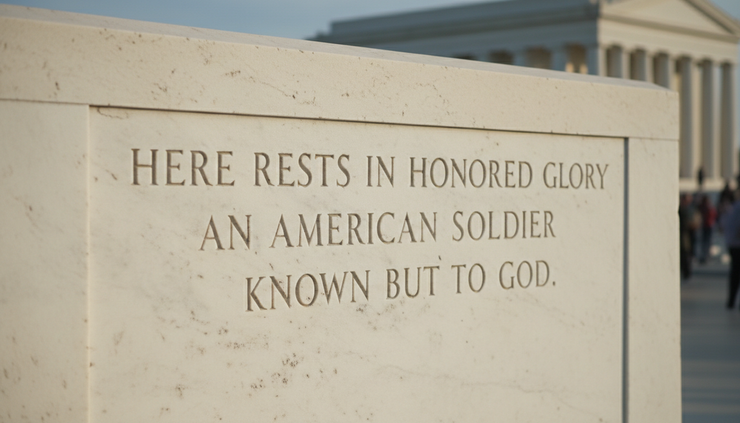
The inscription on the tomb reads, “Here rests in honored glory an American soldier known but to God.” Those words remain among the most recognized lines at Arlington. They are plain, brief, and powerful. They name no battle and no rank.
The first grave of the Unknown Soldier was marked by a simple marble slab. The large white marble sarcophagus seen today came later.
The tomb was completed in the early 1930s and became one of the most recognizable memorials in the country. Its clean lines, carved figures, and bright stone give it a formal presence, but the meaning remains deeply personal.
The tomb’s east panel includes three carved figures representing Peace, Victory, and Valor. The symbolism reflects both mourning and national gratitude. The monument honors courage, but it does not glorify war. Its setting at Arlington keeps the focus on service members who paid the highest price.
After World War II and the Korean War, the United States again faced the painful reality of unidentified remains. On Memorial Day in 1958, unknown service members from World War II and the Korean War were interred at the tomb. President Dwight D. Eisenhower, who had commanded Allied forces in Europe during World War II, took part in the ceremony.
The World War II unknown represented service members from a global conflict fought across Europe, North Africa, the Pacific, and beyond. The Korean War unknown represented those who died in a brutal conflict marked by harsh terrain, bitter weather, and shifting front lines.
Their burial expanded the meaning of the tomb. It was no longer only a World War I memorial. It became a national shrine for unidentified U.S. service members from multiple wars.
The tomb reminds visitors that military sacrifice is not limited to famous battles or familiar names. Some stories end without a known grave marker. Some families never received certainty.

The Vietnam War brought another chapter to the history of the tomb, but it also changed how Americans think about identification, memory, and responsibility.
In 1984, an unknown service member from the Vietnam War was interred at the Tomb of the Unknown Soldier. President Ronald Reagan took part in the ceremony, and the burial followed the pattern set by earlier generations.
But science was changing. DNA testing and other forensic methods grew more powerful in the years that followed. The remains in the Vietnam crypt were later examined, and in 1998 they were identified as Air Force 1st Lt. Michael Joseph Blassie.
Blassie had been shot down in 1972. After his identification, his remains were returned to his family for burial.
This moment was historic. For decades, the purpose of the tomb had been to honor those who could not be named. Now, one of the unknowns had been given back his name.
The Vietnam crypt remains empty today. Its cover honors missing U.S. service members from that era. That empty space carries its own meaning. It reflects a promise to continue searching, identifying, and returning the missing when possible.
One of the most memorable parts of visiting the tomb is watching the sentinels. The Tomb Guard comes from the 3rd U.S. Infantry Regiment, known as “The Old Guard.” These soldiers maintain a constant watch over the tomb.
The guard has been continuous every hour of every day since 1937. Rain, snow, summer heat, and national crisis do not stop the watch.
The ceremony is precise and quiet. The sentinel walks a set number of steps across the mat, pauses, turns, changes the weapon to the outside shoulder, and returns. The movements reflect discipline and respect.
Many details carry symbolic meaning:
Twenty-one steps: This number reflects the 21-gun salute, one of the highest military honors.
A measured pause: The guard pauses for 21 seconds before turning.
The outside shoulder: The rifle stays on the shoulder away from the tomb, symbolically placing the guard between the tomb and any threat.
The Changing of the Guard draws many visitors, but it is not a show, it is a ritual of duty. The silence around it matters. The careful movements matter. Even the sound of shoes on stone becomes part of the experience.
Becoming a Tomb Guard requires intense training and high standards. Those who earn the Tomb Guard Identification Badge join a small group entrusted with one of the military’s most visible responsibilities.
The Tomb of the Unknown Soldier holds power because it speaks to loss in its most difficult form. A known grave gives a family a place, a name, and a date. An unknown grave leaves questions. The tomb answers those questions in a national way. It says that even without a name, a life still matters. Even without identification, sacrifice still deserves honor.
It also reminds the public that freedom has a human cost. The people buried at Arlington were not symbols when they lived. They were sons, daughters, parents, friends, neighbors, and fellow citizens. Some volunteered. Some were drafted. Some served in famous campaigns. Others died in places most Americans rarely think about.

The Incredible History Behind the Tomb of the Unknown Soldier is not only a story about monuments and ceremonies. It is a story about how a nation chooses to remember people it cannot name.
From the first World War I burial in 1921 to the addition of unknowns from World War II and Korea, and from the Vietnam unknown’s identification to the continuing watch by the sentinels, the tomb: Honors the missing. Comforts the grieving. Teaches the living.
A visit to Arlington National Cemetery can be overwhelming because the scale of sacrifice is visible in every direction. The Tomb of the Unknown Soldier gives that sacrifice a single focal point. It asks for silence, not because there is nothing to say, but because some gratitude is too deep for ordinary words.


Comments