
The Historic Polegreen Presbyterian Church And Why It Matters


Founding Father Patrick Henry And The Polegreen Church

The Polegreen Presbyterian church matters because it connects faith, free speech, and the American Revolution in one compact place. It was here, in colonial Virginia, that a young Patrick Henry heard preaching that helped shape his voice, his convictions, and his understanding of liberty.
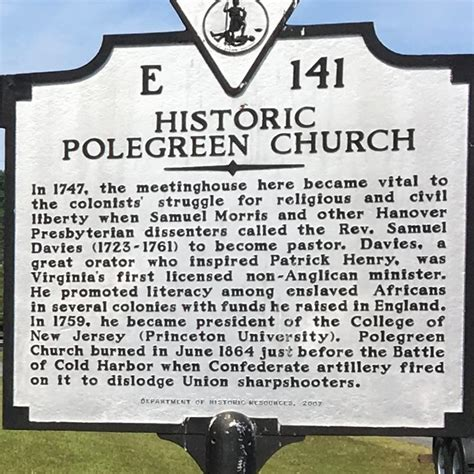
He later became famous for “Give me liberty, or give me death!” Yet long before that speech entered American memory, Henry sat under the influence of a gifted Presbyterian minister named Samuel Davies. Henry credited Davies’s preaching and mentorship with forming much of his patriotism and public speaking power.
In colonial Virginia, the Church of England held official status. That meant dissenting groups, including Presbyterians, often faced legal and social pressure. Polegreen grew out of that world.
The congregation was part of a larger movement of people who wanted to worship outside the established church. For them, gathering at Polegreen was not just a religious act. It was also a quiet claim that conscience should not be controlled by the state.
That idea would later become central to American political thought.
The original Polegreen meeting house stood in Hanover County, north of Richmond. It was simple compared with the grand Anglican churches of the period, but its influence reached far beyond its size. People came to hear sermons, discuss ideas, and take part in a form of religious life that prized conviction over ceremony.
This is one reason Historic Polegreen Church remains so important. It helps explain how arguments for religious freedom took root before the Revolution.
Patrick Henry was born in Hanover County in 1736. As a boy, he attended Polegreen with his mother, Sarah Winston Syme Henry. The minister he heard there, Samuel Davies, became one of the most admired Presbyterian preachers in colonial America.
Davies had a rare gift. He combined moral seriousness with vivid language, emotional force, and careful reasoning. He did not merely lecture. He persuaded.
For a young listener like Henry, that mattered.
Henry later became known as one of the most powerful speakers of the Revolutionary era. His speeches were not polished in the same way as Thomas Jefferson’s writing or James Madison’s arguments. Henry’s strength was presence. He could move a room. He could make political danger feel immediate and personal.
That kind of force had roots.
Henry himself recognized Davies as a major influence on his oratory. He saw in Davies a model of how speech could awaken courage, sharpen conviction, and turn belief into action. The pulpit at Polegreen became, in a sense, an early classroom for one of America’s great public voices.
When people ask which Founding Fathers attended Polegreen, the clearest and best documented figure is Patrick Henry. He was not a side character in the Revolution. He was a leading advocate for independence, a governor of Virginia, and one of the most memorable voices against British rule.
Still, Polegreen’s story is not mainly about a guest list.
Its deeper importance lies in how it formed the ideas and habits that later shaped the founding generation. The church stood for several principles that became central to the American cause:
Liberty of conscience: People should be free to worship according to conviction.
Resistance to unchecked authority: Civil power should not dictate belief.
Speech as a force for public life: Words could stir people to courage and action.
Community built around principle: Ordinary neighbors could gather around shared convictions and change public life.
Patrick Henry carried those lessons into the political world. His patriotism did not appear suddenly in 1775. It grew from family, place, faith, study, and the voices he heard as a young man.
Polegreen was one of those voices.
The original Polegreen Church did not survive intact. During the Civil War, the building was destroyed in the fighting around Richmond and Hanover County. The loss could have erased the site from public memory.
Instead, the absence became part of the story.
Today, visitors do not step into a fully rebuilt colonial church. They encounter a modern open-air frame that outlines the shape of the original meeting house. The design is striking because it does not pretend the past is untouched. It acknowledges loss while still marking presence.
You can stand inside the outline and imagine the congregation gathered there. You can picture a young Patrick Henry listening from among the people. You can sense how a plain meeting house became connected to some of the largest questions in American life.
What does liberty require? Who gets to speak? What power should government have over belief?
Polegreen is not the kind of historic site that overwhelms with artifacts. Its power is quieter. It asks visitors to connect a place, a person, and an idea.
The place is a colonial meeting house in Hanover County.
The person is Patrick Henry, formed in part by what he heard there.
The idea is freedom of conscience, joined with the power of speech.
That combination helps explain why Henry became such a force in the movement toward independence. He did not simply argue that liberty was useful. He made people feel that liberty was worth sacrifice.
Davies helped show him how language could carry moral weight. Polegreen gave him a setting where faith, courage, and public speech met. Virginia gave him the political crisis that turned those gifts toward revolution.
The result helped shape the nation.
Polegreen Church reminds us that history often begins in modest places. A plain meeting house. A preacher’s voice. A young listener who remembers what he heard.
Patrick Henry’s later fame can make his patriotism seem inevitable, but it was shaped over time. The mentorship and example he found through Samuel Davies at Polegreen helped train his ear, his conscience, and his courage.
That is why this Virginia site matters. It is not only a memorial to a lost church. It is a reminder that the American founding was shaped by ideas spoken aloud, heard deeply, and carried into action.


The "Informed Citizen" is a Judeo-Christian conservative blog and website dedicated to providing information on our Constitution and the country's governance, enabling you, the voter, to make informed decisions at the ballot box.
If you are interested in participating in Zoom classes to learn about our Constitution, what the Constitution actually states, the meaning behind the Articles, the history behind its creation, along with informational conversations, please visit americaninsanity.org and subscribe to “The Informed Citizen.”
Together, our voices as Judeo-Christian conservatives will resonate more powerfully than ever.
Please share this post with your contacts. Everyone needs to be an informed citizen so they, too, can better understand our Constitution, what our elected officials are doing to support or abuse it, and thereby make informed decisions at the ballot box.
Neither the “Informed Citizen” Blog nor I, the editor and owner of this blog, am in any way affiliated with or speak on behalf of any political party or individual. What is posted are researched facts or, when appropriate, identified as being "My Opinion."

Comments